
How Costa del Sol and Costa Blanca balance yield and stability in Spain’s property market
1. A Divided Coastline — One Investment Opportunity
Spain’s Mediterranean coast is not a single market — it’s a patchwork of micro-economies shaped by tourism, demographics, and investor behavior.
Two regions dominate conversations about real estate performance: Costa del Sol and Costa Blanca.
At first glance, both share similar traits — sunshine, tourism, and strong rental demand.
But when you look deeper into the data, the story changes: their price dynamics, yield profiles, and rental patterns diverge sharply.
According to Best Yield Finder, these two coasts are not rivals, but strategic complements.
While Costa del Sol delivers long-term price security, Costa Blanca compensates with stronger rental income per euro invested.
A balanced investor knows how to combine both to build a resilient portfolio.
2. Costa del Sol — The Capital of Stability
Stretching from Málaga to Estepona, the Costa del Sol remains Spain’s most consolidated coastal market.
Its reputation attracts both lifestyle buyers and professional investors who value liquidity, infrastructure, and long-term appreciation.
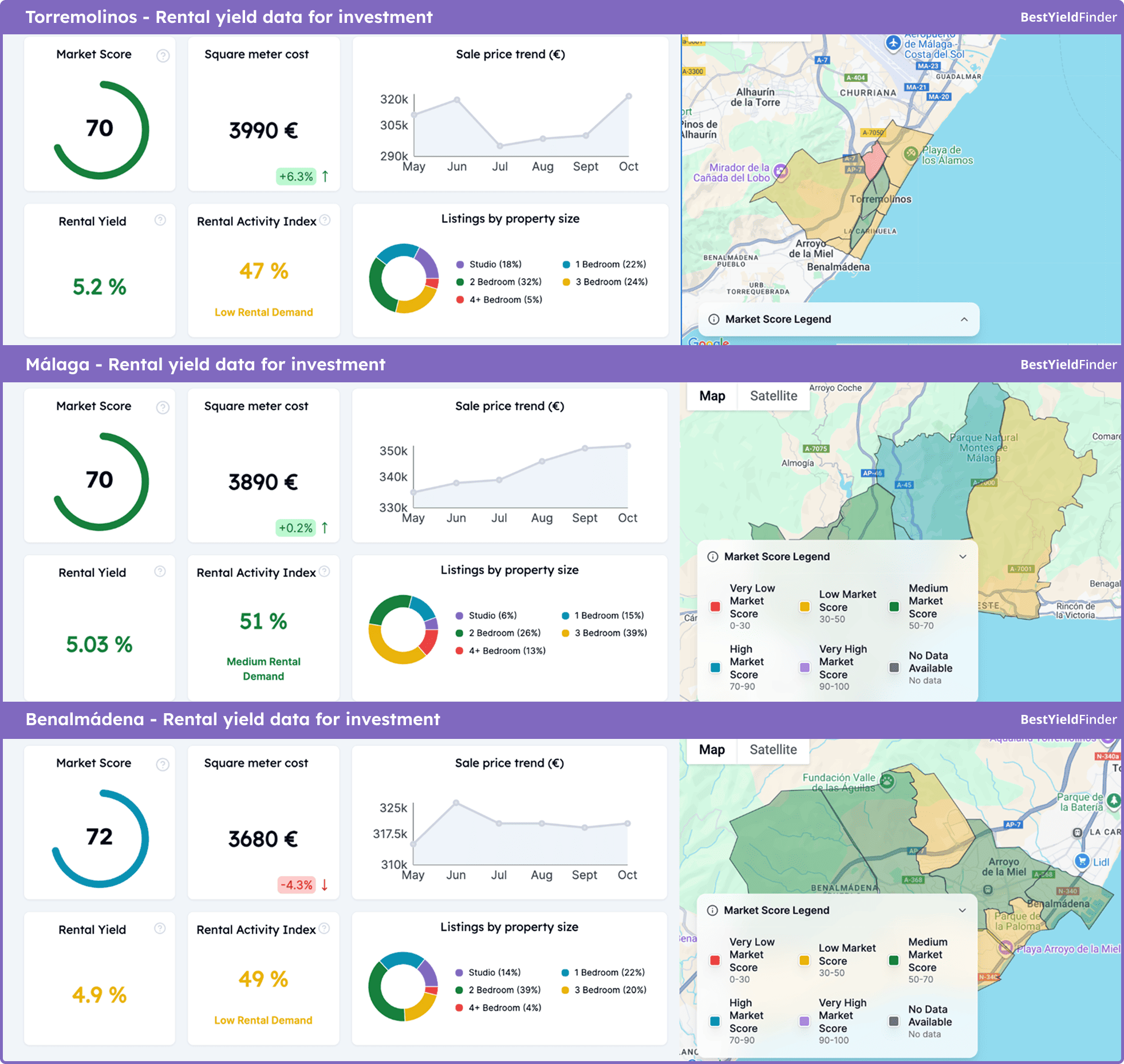
Source: www.bestyieldfinder.com, www.idealista.com
BYF data shows:
Torremolinos: 5.20% yield | €3,990/m² | rental activity 47%
Málaga: 5.03% yield | €3,890/m² | rental activity 51%
Benalmádena: 4.90% yield | €3,680/m² | rental activity 49%
These figures define Costa del Sol as a low-volatility, high-liquidity market.
It’s where returns may not spike, but risk-adjusted performance remains among the best in Spain.
Average across the region:
Yield ≈ 5.0%
Price ≈ €3,850/m²
Investor insight:
- Prices here have proven resistant to downturns.
- Rental demand is diversified — from digital nomads to retirees.
- Even with moderate yields, the overall ROI remains strong due to steady appreciation and low vacancy.
In a portfolio, Costa del Sol acts as the “anchor region” — a stable base for long-term wealth preservation.
3. Costa Blanca — Spain’s Yield Laboratory
Moving east, the Costa Blanca — from Alicante to Benidorm — offers a striking contrast.
The entry prices are lower, returns higher, and the markets more dynamic.
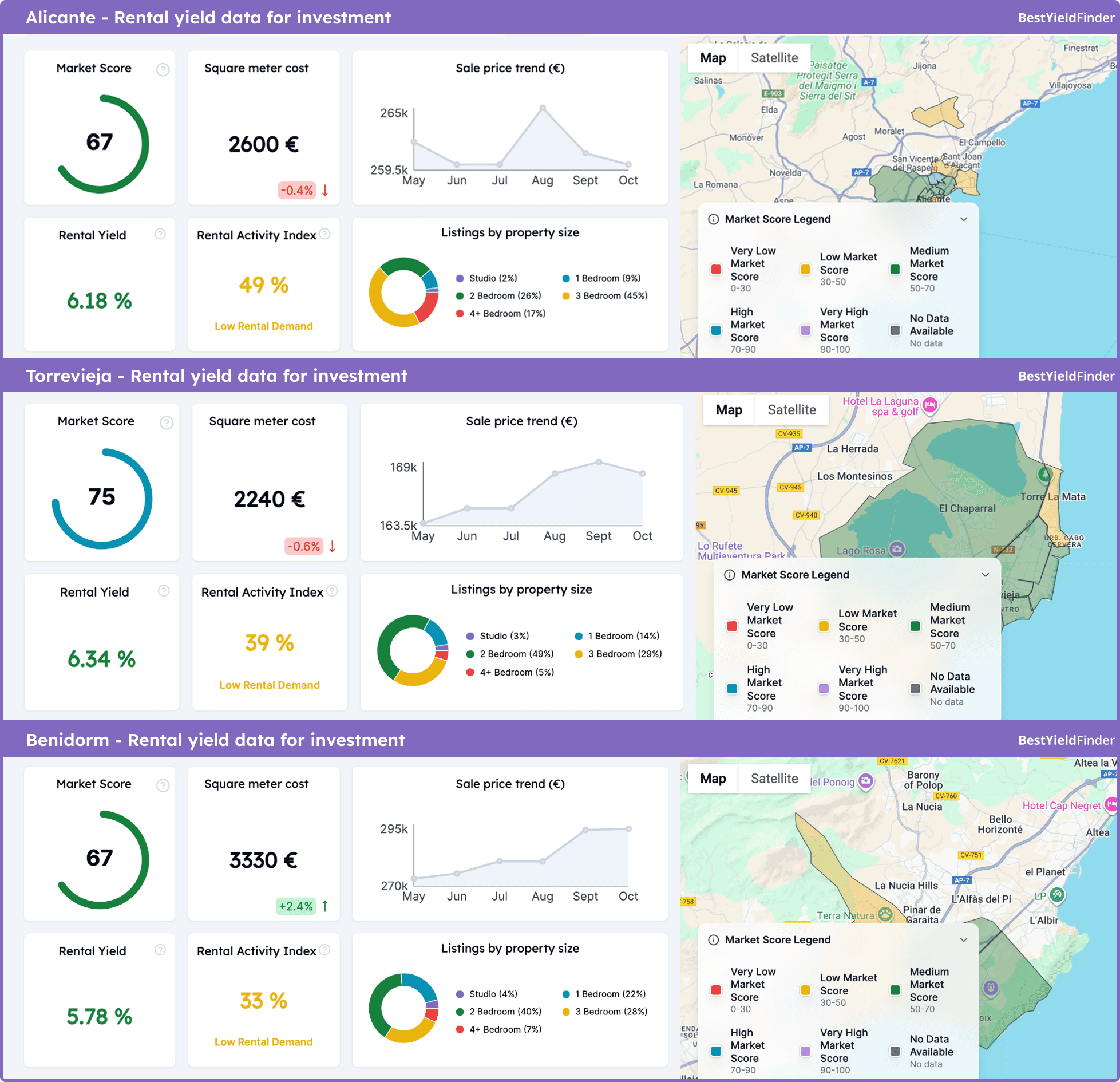
Source: www.bestyieldfinder.com, www.idealista.com
BYF data shows:
Alicante: 6.18% yield | €2,600/m² | rental activity 49%
Torrevieja: 6.34% yield | €2,240/m² | rental activity 39%
Benidorm: 5.78% yield | €3,330/m² | rental activity 33%
Here, investors prioritize cash flow and return velocity over long-term capital gain.
Average across the region:
Average across the region:
Yield ≈ 6.1%
Price ≈ €2,700/m²
Investor insight:
- Entry cost is up to 40% lower than Costa del Sol.
- Yields surpass the national average (≈5.4%).
- Torrevieja and Alicante remain top performers for short-term rentals.
Costa Blanca’s market is more fragmented and seasonal — yet highly efficient.
It rewards active investors who manage operations well or leverage data tools to identify high-performing submarkets.
For those seeking immediate income and faster ROI, Costa Blanca acts as the “yield engine” in a balanced portfolio.
4. Comparing the Two — Yield vs. Stability
| Region | Avg €/m² | Avg Yield | Rental Activity |
|---|---|---|---|
| Costa del Sol | €3,853 | 5.0% | ~49% |
| Costa Blanca | €2,723 | 6.1% | ~40% |
The difference is structural:
Costa del Sol benefits from price appreciation, mature infrastructure, and global appeal.
Costa Blanca delivers stronger rental margins and lower acquisition costs.
Neither is “better.” Together, they balance each other — like bonds and equities in a financial portfolio.
A 60/40 allocation between the two can smooth returns while maintaining exposure to Spain’s strongest rental zones.
5. Building a Data-Driven Portfolio
Before tools like BYF, investors often relied on intuition or agents’ opinions.
Now, with granular analytics by city, price segment, and rental activity, decision-making is transparent and measurable.
With BYF you can:
Compare dozens of cities by yield, liquidity, and price.
Filter properties by budget range, size, and rental type.
Instantly identify underpriced yield pockets across both coasts.
This transforms investing from speculation into portfolio engineering.
For example, an investor might allocate:
- Core assets in Málaga or Benalmádena for stability (≈5% yield).
- High-yield assets in Torrevieja or Alicante (≈6–6.5% yield). The combined portfolio reaches a blended yield of ~5.5% with geographic diversification.
6. Trends to Watch
The Spanish market is evolving fast, and data from BYF highlights a few patterns worth watching:
- Shift to professional investors: Individual buyers now use data tools once reserved for institutions.
- Micro-markets outperform cities: Yields can differ 1–2% within a single municipality.
- Growing rental transparency: Platforms like BYF track real-time shifts in demand and supply.
- Sustainability of returns: Mid-term rentals and local tenants provide increasing stability versus pure tourism.
These trends indicate a maturing market where data literacy is becoming a competitive advantage.
7. Final Insight
Both coasts share the same sun — but not the same returns.
Costa del Sol represents strength, liquidity, and resilience.
Costa Blanca brings dynamism, yield, and growth potential.
Smart investors don’t choose between them — they use data to design balance.
And that balance begins with Best Yield Finder — turning raw numbers into real strategy.
Explore Spain’s live yield data at bestyieldfinder.com