
Buying property in a cheaper city can feel like the obvious way to improve investment returns.
Lower purchase price means less capital required.
But does it actually mean a higher rental yield?
Not necessarily.
The relationship depends on both sides of the equation:
Property Price ↔ Rental Income
A city can be inexpensive because property prices are low — but rents may also be low.
At the same time, an expensive city can still produce attractive rental yields if tenant demand supports sufficiently high rents.
Using BestYieldFinder data from October 2026, we compared selected apartment markets across Italy, Spain, Poland, Portugal and France to answer a simple question:
Are cheaper cities actually more profitable for rental investors?
Cheaper does not automatically mean more profitable
A lower purchase price only improves rental economics when achievable rent remains strong relative to that price.
How we compare cheaper and more expensive cities
For each market, we look at three basic metrics:
- median apartment purchase price
- median monthly rent
- average gross rental yield
Gross rental yield measures annual rental income relative to the property’s purchase price.
In simplified terms:
Gross Rental Yield = Annual Rent / Property Price × 100
The higher the rent relative to the purchase price, the stronger the gross yield.
However, there is an important methodological point.
BestYieldFinder city yields are based on apartment-segment data and city values are calculated as weighted averages of segment yields. Therefore, the published city yield may not exactly equal a simple calculation using the displayed city-level median price and median rent.
This is a gross-yield comparison
Gross yield does not include taxes, maintenance, vacancy, financing, management costs or other ownership expenses. It is useful for comparing markets, but it is not the same as net profitability.
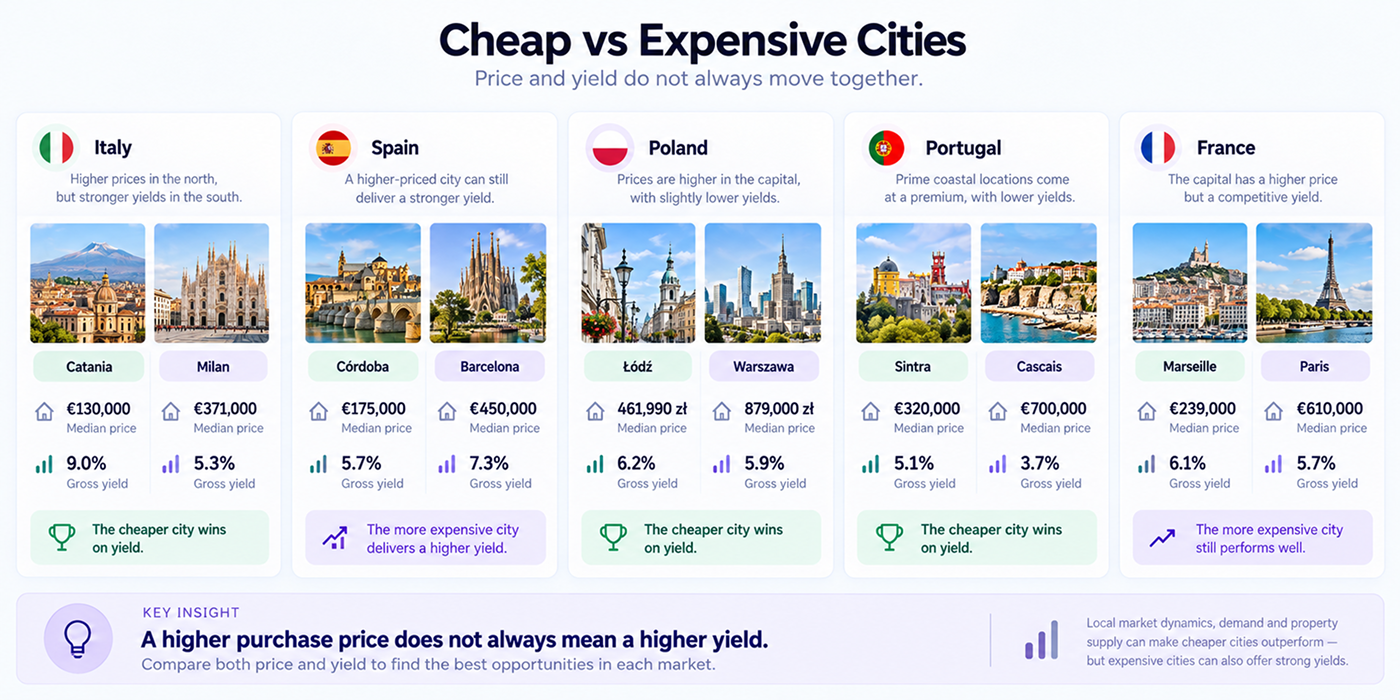
Italy: cheaper cities clearly outperform Milan
Italy provides one of the clearest examples of lower entry prices translating into stronger rental yields.
| City | Median Purchase Price | Median Monthly Rent | Gross Yield |
|---|---|---|---|
| Catania | €130,000 | €700 | 9.0% |
| Palermo | €150,000 | €750 | 8.4% |
| Turin | €165,000 | €950 | 8.2% |
| Rome | €310,000 | €1,500 | 6.9% |
| Milan | €371,000 | €1,400 | 5.3% |
Source: BestYieldFinder Italy Rental Yields, October 2026.
The pattern is strong.
Catania’s median apartment purchase price is roughly one-third of Milan’s, while its average gross yield is significantly higher.
The same pattern appears in Palermo and Turin.
Milan generates substantially higher rents than these markets, but those rents are not high enough to compensate for its much higher acquisition price.
Catania vs Milan
Catania
- Purchase price: €130,000
- Monthly rent: €700
- Gross yield: 9.0%
Milan
- Purchase price: €371,000
- Monthly rent: €1,400
- Gross yield: 5.3%
Milan’s median rent is twice as high.
But its median purchase price is almost three times higher.
That difference changes the investment economics.
Rent alone tells only half the story
Milan generates more rental income in absolute terms, but Catania generates significantly more gross rental income relative to the capital required to buy the property.
Italy therefore supports the idea that lower-cost cities can offer stronger rental yields.
But other countries show why this rule cannot be applied blindly.
Spain: Barcelona breaks the “cheap is better” rule
Spain provides a very different picture.
| City | Median Purchase Price | Median Monthly Rent | Gross Yield |
|---|---|---|---|
| Córdoba | €175,000 | €790 | 5.7% |
| Alicante | €258,000 | €1,290 | 6.5% |
| Valencia | €325,000 | €1,600 | 6.2% |
| Barcelona | €450,000 | €2,460 | 7.3% |
| Madrid | €473,950 | €1,950 | 5.6% |
Source: BestYieldFinder Spain Rental Yields, October 2026.
Córdoba has the lowest median purchase price in this group.
But it does not have the highest yield.
That position belongs to Barcelona.
Córdoba vs Barcelona
Córdoba:
€175,000 → €790/month → 5.7% yield
Barcelona:
€450,000 → €2,460/month → 7.3% yield
Barcelona is much more expensive to enter.
But rental income is also dramatically higher.
The result is an important counterexample:
An expensive city can still outperform a cheaper city when rent is sufficiently strong relative to property prices.
Barcelona’s apartment segments reinforce this point.
Current gross yields include approximately:
- Studio: 8.1%
- 1BR: 7.8%
- 2BR: 7.2%
- 3BR: 7.7%
- 4+BR: 6.5%
High property prices do not automatically mean low yields
Expensive markets can still offer attractive rental economics when tenant demand supports sufficiently high rents.
Madrid also shows why expensive markets should not be grouped together.
Its median purchase price is slightly higher than Barcelona’s, but its average gross yield is only 5.6%.
So the question is not simply whether a city is expensive.
It is whether rent grows proportionally with the purchase price.
Poland: lower entry prices generally help
Poland shows a more traditional relationship between price and rental yield.
| City | Median Purchase Price | Median Monthly Rent | Gross Yield |
|---|---|---|---|
| Łódź | 461,990 zł | 2,200 zł | 6.2% |
| Szczecin | 569,000 zł | 2,700 zł | 6.3% |
| Kraków | 799,000 zł | 2,990 zł | 4.9% |
| Warszawa | 879,000 zł | 3,900 zł | 5.9% |
Source: BestYieldFinder Poland Rental Yields, October 2026.
Łódź has the lowest median purchase price among these markets and produces a 6.2% city-level gross yield.
Szczecin is slightly more expensive but reaches 6.3%.
Meanwhile, Kraków has a significantly higher median purchase price but the weakest average yield in this comparison at 4.9%.
Warszawa is the most expensive market in the group and delivers 5.9%.
Cheap does not mean “cheapest wins”
There is another useful lesson here.
Łódź is cheaper than Szczecin.
But Szczecin has the slightly higher average yield.
That means even when lower-cost markets generally outperform expensive ones, ranking cities by purchase price alone still does not identify the best yield.
Use price to narrow the search, not finish it
Lower-cost cities can create attractive entry points, but investors still need to compare how much rent each market generates relative to that price.
Portugal: lower-cost markets outperform premium locations
Portugal provides another relatively clear example.
| City | Median Purchase Price | Median Monthly Rent | Gross Yield |
|---|---|---|---|
| Braga | €299,900 | €1,100 | 4.6% |
| Sintra | €320,000 | €1,350 | 5.1% |
| Lisbon | €599,900 | €1,800 | 4.1% |
| Cascais | €700,000 | €2,000 | 3.7% |
Source: BestYieldFinder Portugal Rental Yields, October 2026.
The difference between Sintra and Cascais is particularly revealing.
Sintra vs Cascais
Sintra
- Purchase price: €320,000
- Rent: €1,350
- Gross yield: 5.1%
Cascais
- Purchase price: €700,000
- Rent: €2,000
- Gross yield: 3.7%
Cascais generates €650 more rent per month.
But its median purchase price is more than twice as high.
As a result, Sintra provides stronger gross rental economics.
Interestingly, Braga is even cheaper than Sintra but its yield is lower at 4.6%.
Again:
The cheapest market is not automatically the highest-yield market.
The ideal combination is not simply the lowest price
The strongest setup is a relatively affordable purchase price combined with rent that remains strong enough to support the investment.
France: price and yield do not move in a straight line
France provides perhaps the best example of why the relationship is more complicated than “cheap city = high yield.”
| City | Median Purchase Price | Median Monthly Rent | Gross Yield |
|---|---|---|---|
| Nantes | €212,930 | €790 | 5.3% |
| Marseille | €239,000 | €850 | 6.1% |
| Lyon | €310,000 | €760 | 5.4% |
| Paris | €610,000 | €2,440 | 5.7% |
Source: BestYieldFinder France Rental Yields, October 2026.
Marseille combines a relatively low purchase price with the highest yield in this group.
That fits the cheaper-city hypothesis.
But Paris complicates the picture.
Paris has by far the highest median purchase price:
€610,000
Yet its average gross rental yield is 5.7%, higher than both Nantes and Lyon.
Why?
Because its median monthly rent is also dramatically higher:
€2,440
Paris therefore demonstrates the same principle as Barcelona.
A premium market can still produce competitive rental economics when rental income remains strong enough.
Premium markets can still compete
High acquisition costs are not automatically a problem if the rental market supports proportionally higher income.
So are cheaper cities actually more profitable?
Based on these examples, the answer is:
Often — but not automatically.
Several lower-cost cities clearly outperform more expensive alternatives:
- Catania vs Milan
- Palermo vs Milan
- Łódź vs Kraków
- Szczecin vs Kraków
- Sintra vs Lisbon
- Sintra vs Cascais
- Marseille vs Paris
But there are equally important exceptions.
Barcelona is substantially more expensive than Córdoba or Alicante, yet its city-level gross yield is higher.
Paris is much more expensive than Nantes or Lyon, yet its rental yield remains competitive because rents are significantly higher.
So the relationship looks more like this:
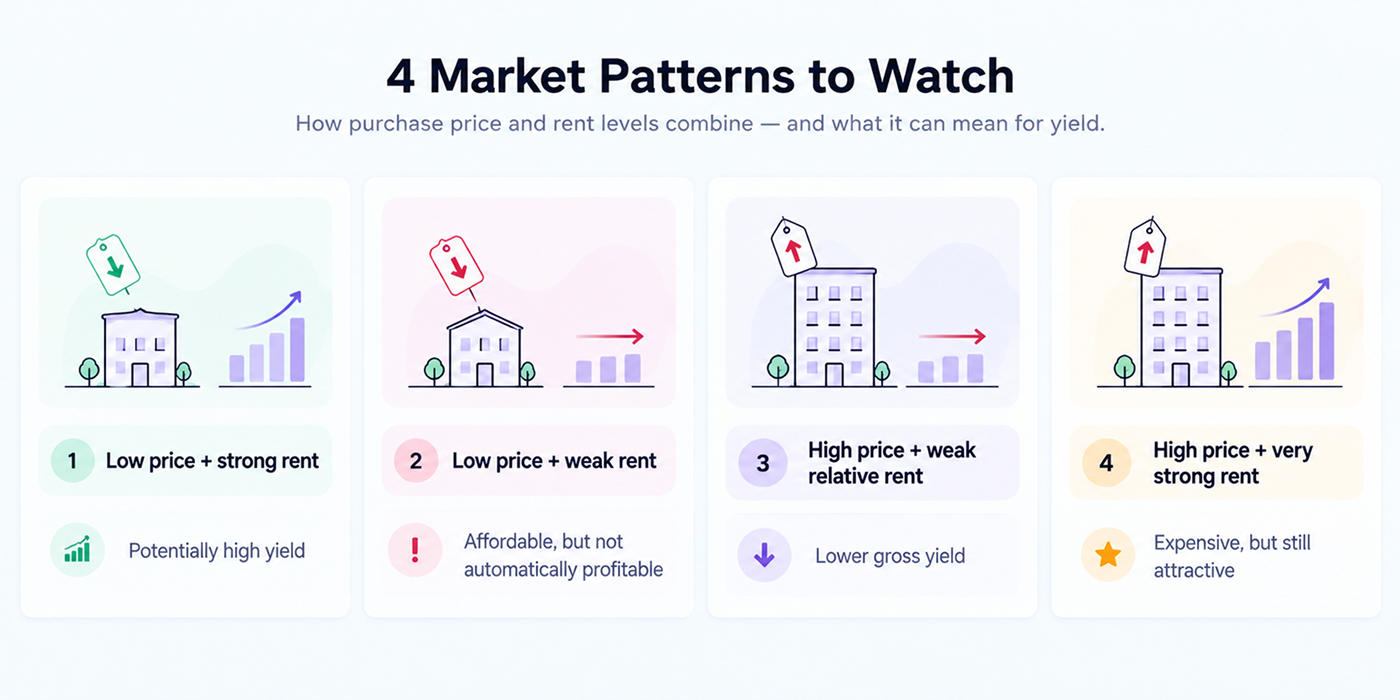
Scenario 1 — Low price + strong rent
Potentially high yield
This is the most attractive version of the “cheap city” thesis.
Examples include markets such as Catania and Marseille.
Scenario 2 — Low price + weak rent
Affordable, but not necessarily highly profitable
A property can be cheap because both purchase prices and rental demand are lower.
Scenario 3 — High price + weak relative rent
Lower gross yield
This can happen when property values rise much faster than achievable rents.
Scenario 4 — High price + very strong rent
Expensive, but still potentially attractive
Barcelona demonstrates this particularly well.
Profitability comes from the relationship between price and rent
Purchase price matters, but rental income must always be analyzed alongside it.
A €200,000 property is not automatically better than a €400,000 property
Imagine two simplified investments.
Property A
Purchase price: €200,000
Monthly rent: €800
Annual rent: €9,600
Gross yield:
4.8%
Property B
Purchase price: €400,000
Monthly rent: €2,400
Annual rent: €28,800
Gross yield:
7.2%
Property B requires twice as much capital.
But its rent is three times higher.
That makes it more efficient from a gross rental-income perspective.
Ask how much rent every euro of property value produces
Instead of asking only whether a property is cheap or expensive, compare how much rental income the purchase price is able to generate.
Apartment type can change the conclusion again
City averages are only the beginning.
Different apartment types can produce very different yields within the same city.
For example, current BestYieldFinder data shows:
- Catania 1BR: 10.5%
- Genoa 2BR: 10.7%
- Barcelona studio: 8.1%
- Łódź 1BR: 7.6%
- Marseille 1BR: 7.1%
- Sintra 3BR: 5.7%
This means an investor comparing only city averages may miss a much stronger segment within the same market.
The relationship can therefore become:
Country → City → District → Apartment Type → Property
The deeper the analysis goes, the less useful the simple label “cheap city” becomes.
Investors can explore these differences using the BestYieldFinder Yield Finder.
District-level analysis can change the picture even further
The same effect appears within cities.
One district may combine:
low purchase price + strong rent + high yield
while another district in the same city may have:
premium purchase price + similar rent + much lower yield
For example, city-center or prestige districts often command significant purchase-price premiums.
Rents may also be higher — but not always enough to maintain the same yield.
City averages can hide local opportunities
A market that looks average at city level can contain individual districts with very different rental economics.
This is why Location Explorer can be useful for identifying markets first, while Yield Finder can help move toward more specific local combinations.
Lower price still has advantages beyond yield
Even when a cheaper city does not have the absolute highest gross yield, a lower entry price can still matter.
It may mean:
- less capital required
- lower financing requirements
- easier diversification across multiple properties
- potentially lower absolute renovation costs
- lower exposure to a single asset
- greater flexibility for first-time investors
For example, investing €600,000 into one property is structurally different from allocating the same capital across several €150,000–€200,000 properties.
But those advantages need to be weighed against:
- local tenant demand
- liquidity
- vacancy risk
- appreciation potential
- management complexity
- transaction costs
Low price can reflect weaker fundamentals
Cheap real estate may be cheap for a reason. Lower demand, weak population growth, limited employment or poor liquidity can reduce the attractiveness of a seemingly high-yield property.
Gross yield is only the first filter
A market showing 8% gross yield is not automatically a better investment than one showing 6%.
Gross yield does not directly account for:
- taxes
- maintenance
- renovation
- insurance
- property management
- vacancy
- financing
- regulation
- transaction costs
That is why investors should use gross yield to identify interesting opportunities — and then analyze the full investment case.
The BestYieldFinder ROI Calculator can help test how different costs and assumptions affect the final return.
How to compare cheap and expensive markets
A practical process could look like this:

1. Compare entry prices
Identify cities that fit the available investment budget.
2. Compare rents
Check whether lower prices also come with dramatically lower rental income.
3. Compare gross yields
Measure rent relative to acquisition price.
4. Compare apartment types
Look beyond city averages.
5. Go down to district level
Find local areas where price and rent create stronger combinations.
6. Compare actual properties
Use BestYieldFinder Properties to move from market-level analysis to current listings.
7. Calculate the real investment case
Include acquisition costs, vacancy, maintenance and other expenses before making a decision.
Start broad and narrow the search
Compare countries and cities first, then move through districts and apartment types before evaluating individual properties.
Final thoughts
So, are cheaper cities actually more profitable?
Sometimes.
Italy, Poland and Portugal provide several examples where lower-cost markets produce stronger gross rental yields than more expensive cities.
But Barcelona and Paris show why the rule is far from universal.
The cheapest city is not necessarily the best market.
The most expensive city is not necessarily the worst.
What matters is the relationship between:
Purchase Price + Rental Income + Demand + Costs + Risk
Do not search for the cheapest property — search for the strongest relationship between price and income
A lower entry price becomes an investment advantage only when the rental market is strong enough to support it.
For investors, the goal is not simply to buy where property is cheap.
It is to find markets where the price you pay makes sense relative to the income the property can realistically generate.